
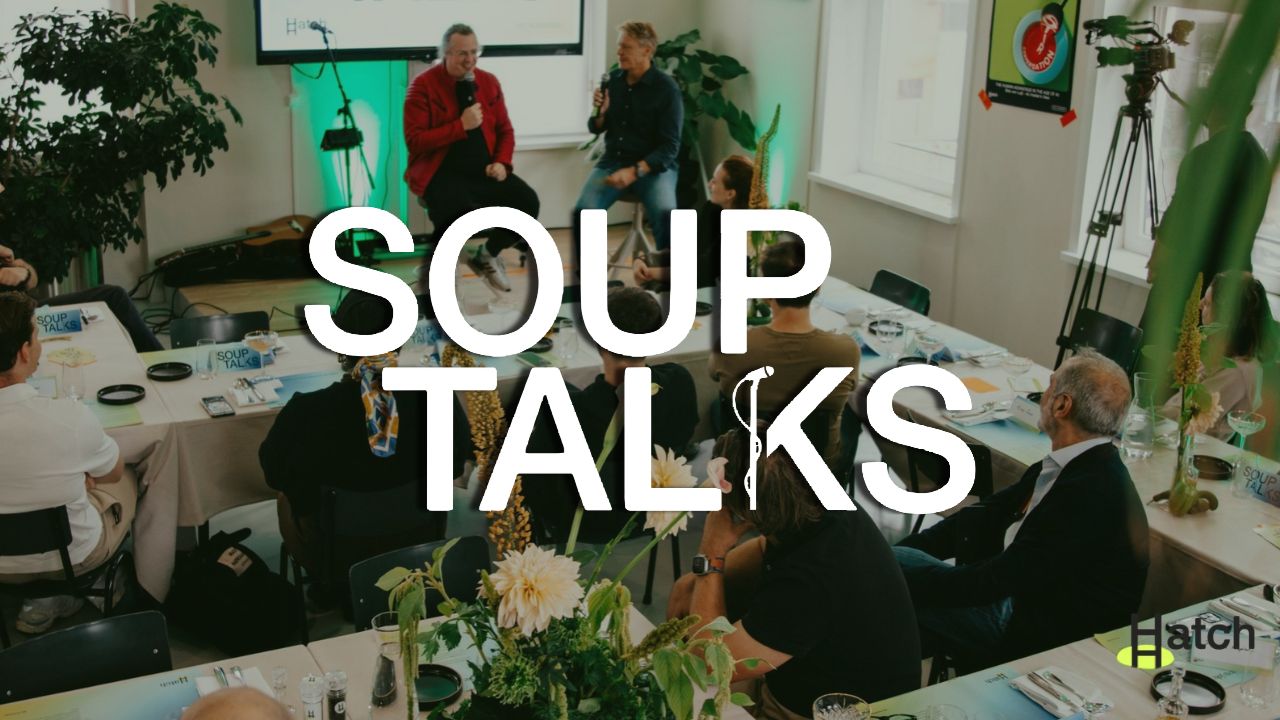
Participants at our first Soup Talk are treated to a warm bowl of soup on the table at Hatch House. Nothing fancy. No elaborate catering. Just warm soup, the kind your grandmother might have made. And without any doubt this is all intentional.
The idea is simple: bring interesting people together, eat together and give the conversation enough time to end up with smiles and enlightening thoughts. Give guest 2 or maybe 3 thinking paths that inspire them and try to reach them as whole humans by reaching out for their body through soup and hearth trough music. If you ever thought that food could be a mdium. Stop doubting. The first SoupTalk proved us right. The inspiration is the Spanish habit of sobremesa, staying at the table after a meal because the conversation isn’t finished yet. No PowerPoints, nore polished panel answers.
As the chef stirred the soup in the kitchen, Joris, partner at Hatch stirred the conversation together with all guests and the CIO (chief inspiration officer) at Hatch for a day, Bob van Luijt, co-founder and CEO of Weaviate, a company operating deep inside today’s AI infrastructure and one of the almost-unicorns born in the Netherlands.
So naturally, we’re here to talk about AI. But not realy. Because the longer we talk about AI the less the conversation seems to be about artificial intelligence. It becomes a conversation about us Humans. Beyond the Algorithm, What Bob van Luijt thinks we should cherish in the age of AI.
Van Luijt is an unusual voice in that debate. Before building one of Europe’s prominent AI companies, he studied jazz. He talks about technology without sounding particularly seduced by technology. Again and again, the conversation returned not to what AI can do, but to what we should do ourselves. Five ideas stood out.
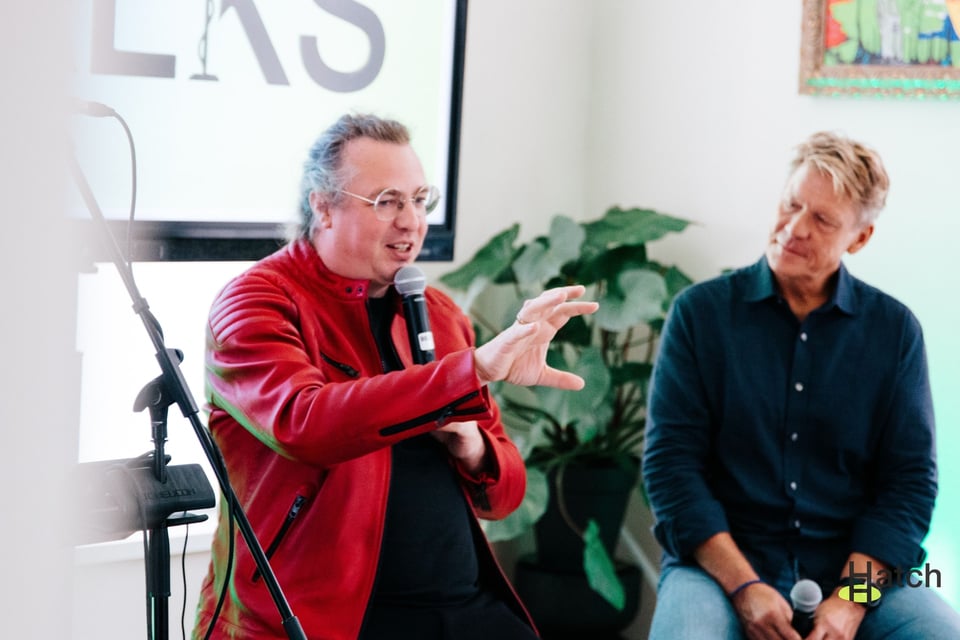
This part of the conversation started with what seems like an obvious question. How does someone go from studying jazz to building an AI company? For van Luijt, apparently, it isn’t such a leap. “I just do what I like to do,” he says. “It’s not so much about the concrete stuff you’re doing; I just like to make stuff.” He has been doing this for a long time. Bob founded his first company at fifteen and, as he tells the room never really worked for a traditional boss.
But the interesting connection between music and entrepreneurship isn’t only the obvious independence. It’s the necessary focus on other people to make it work. When you write music, van Luijt explains, there comes a point when you want to hear it performed. Suddenly, the solitary act of composing becomes social. You need musicians. You have to explain what you imagined, listen to what they bring to it and somehow get everybody moving in roughly the same direction. “And you learn how to deal with people,” he says, smiling, “especially musicians and artists, who are not always the easiest to work with.”
Building a company turns out to be remarkably similar. You can have the idea alone. You cannot execute it alone.
To van Luijt, entrepreneurship feels less like the heroic founder mythology of Silicon Valley and more like composing for a band. There are people, systems and ideas that need to work together. Sometimes they don’t. Sometimes somebody plays something you didn’t expect and it makes the whole thing better.
The conversation is stirred. We ask the room a question: What should we never automate out of our lifes, even if AI allows us to? Someone says pure creativity. Someone else mentions human interaction, the old idea of people sitting around a campfire. Bob takes it somewhere else: we should never automate our struggles.
He brings up Suno, the AI music generator, and a claim associated with its leadership that making music traditionally isn’t much fun because it is so difficult. Van Luijt clearly hates the promise. “The whole point that I studied music is because it’s hard to do,” he says. “That’s what makes it fun.”
It exposes a strange assumption hidden inside much of the technology we build: that time and effort are problems. If something takes ten years to master, surely reducing that to ten seconds must be progress. But what if those ten years are the point? Learning a craft is inefficient. Relationships are inefficient. Working with difficult people is inefficient. Becoming genuinely good at something involves repetition, frustration and a great deal of time in which you appear to be getting nowhere.
Van Luijt tells us about walking the Camino de Santiago with his father. Every morning at breakfast, the same realization: shit, another twenty kilometres. You could remove the problem very easily. Take a taxi. But then, of course, you haven’t walked the Camino. “When you arrive, you go, ‘This is great.’ The pain you go through is the exact reason you enjoy arriving.”
AI can remove friction. In many places, it absolutely should. Nobody needs to find meaning in unnecessary administration. But perhaps we need to become much more precise about the friction we remove. There is meaningless friction, and there is friction that nourishes us. Automate the first but be very careful with the second.
Moving on we focussed on another question. If AI becomes better at more things, which human “muscle” should we deliberately train? Critical thinking comes up. Empathy too. Van Luijt’s answer is shorter. Its all about “Taste”.
He starts talking about something most people in the room immediately recognise: the AI-generated business email. Or the presentation where someone has clearly entered a prompt, copied the answer and put it on slides.
Nothing is technically wrong with it. “That may actually be the problem because I find it extremely tasteless,” van Luijt says. “The thing to train is taste.”
His argument is partly technical. Language models work through probability and generalisation. Feed them enormous amounts of human expression and they become extraordinarily good at finding patterns in it.But probability naturally pulls towards the middle. Towards what is likely and average. And average is rarely where culture becomes interesting.
“All of a sudden,” van Luijt says, laughing, “receiving an email with a typo in it is appreciated by me. I go: ‘This person actually wrote it.’”
Five years ago, he adds, he would have wondered why they hadn’t used spellcheck. There is something funny and slightly disturbing about that reversal. Human imperfection is becoming evidence of human presence. But van Luijt isn’t arguing for bad work. Taste is the opposite. It is the ability to recognise what deserves to survive among infinite possibilities.
AI can generate fifty images. Taste chooses one. It can write twenty headlines. Taste knows that nineteen are forgettable. The technology may become available to everyone. Taste will not, so choose the taste-side.
This moment the collective conversation became less based on social science and a touch of economy filled the room. Van Luijt describes almost every profession as a bell curve. On the left you will find poor work.In the large middle, competent, acceptable, professional work. And on the far right you ‘ll find exceptional work from people with extraordinary skill, judgement or taste.
For a long time, the middle was a perfectly comfortable place to build a career. You didn’t need to be the world’s greatest advertising creative to make good commercials. You didn’t need to be an exceptional writer to earn a living by writing reports. The landing of AI in our daily professional life changed that equation.
“If technology can create stuff in the middle of the curve,” van Luijt says, “it will push human labor to the two far sides.” This is perhaps the most uncomfortable observation of the gathering but a naked truth because AI does not initially need to replace the very best designer, strategist or writer. It needs to replace the perfectly adequate one.
Generic copy. Standard photography. Routine design. Average reports.
Work that businesses once happily paid humans to produce because there was no alternative.
Following this normal distribution curve the people on the right side will use AI as leverage to amplify what they already do exceptionally well. Their judgement remains scarce while their ability to execute grows dramatically.
The middle faces a harder question. “Back in the day, humans sat comfortably in the middle and were paid well to make average commercials or standard reports,” he says. That middle is increasingly available from machines. The conclusion isn’t particularly comforting, but it is clear: being competent may no longer be enough.
In an economy where everybody has access to increasingly capable tools, the advantage shifts from being able to produce something to knowing what is worth producing. Which brings us straight back to taste.
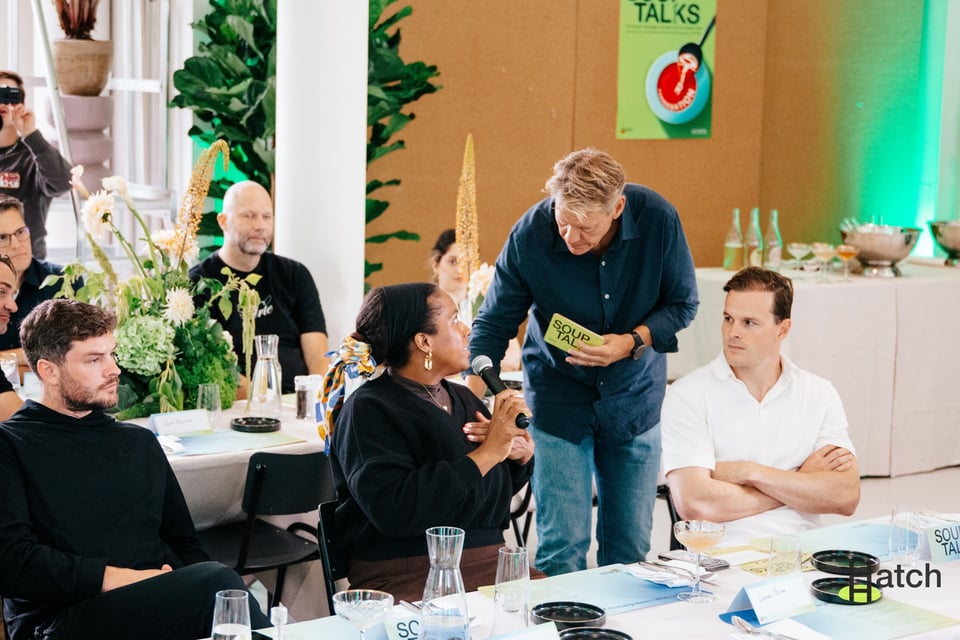
Towards the end, Joris asks Bob a practical simple question. “Fine. AI is here. The middle is under pressure. Taste matters. What should people actually do?”
Bobs answer contains very little comfort. “Don’t sit around complaining. Figure out how to do more and work harder to get to that right side of the distribution,” he says. “Go with it, talk to people, meet people, and figure out where the leverage is.”
But his second answer is more interesting, particularly for younger people. “Find something you genuinely enjoy doing. Then find out where people are doing it at the highest possible level and go learn from them.” Fun plus apprenticeship. It sounds almost old-fashioned in a conversation about artificial intelligence. Perhaps that’s why it lands.
Then van Luijt offers one more possible future scenario and calls this the escape hatch. He mentions university students booing prominent AI CEOs during commencement speeches in the United States. Maybe, he suggests, a younger generation will simply refuse to make AI the centre of its identity. Maybe AI becomes like cloud storage or spreadsheets. Massively important. Everywhere. And fundamentally uninteresting. There is something liberating in that.
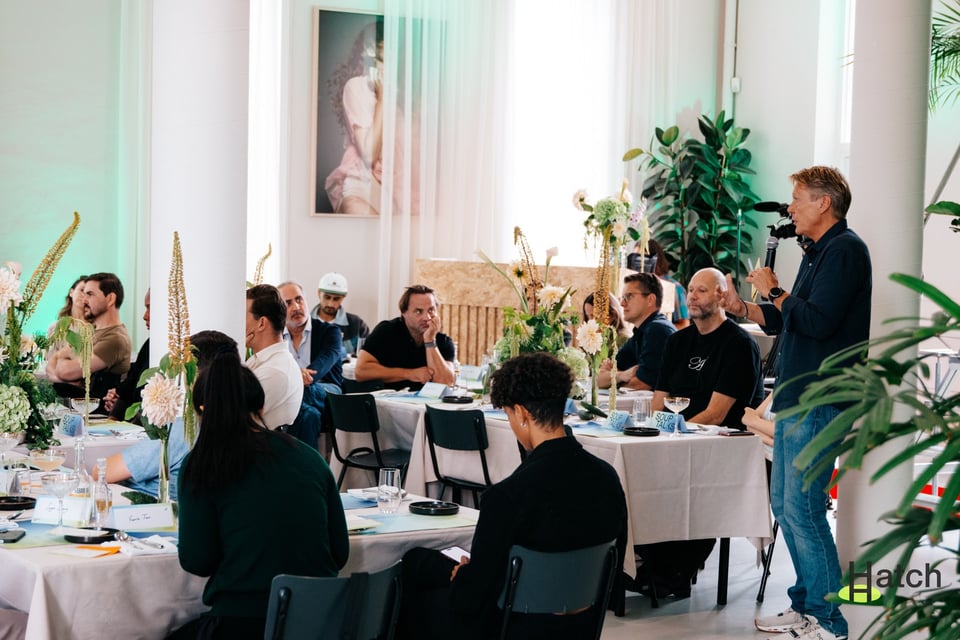
By now, steaming bowls of vegetable soup are arriving at the table. The theoretical discussion about humanity and technology suddenly becomes very physical again. People eat. Someone continues a conversation from earlier. The talk starts loosening around the edges.
Van Luijt mentions one final habit: gratitude. Taking a moment every day to appreciate what you have, the work you do and the fact that you get to do something you love.
AI will become better at calculation, retrieval, writing, images, music and a thousand other things. We should use it. Probably aggressively. But not everything that can be automated should be. Some things are valuable precisely because they take time. Because they are difficult. Because they require other people. Because we occasionally get them wrong.
People worry about machines becoming more human. Walking out of Soup Talks, I found myself wondering about the opposite danger: that in our obsession with efficiency, we might start behaving more like machines.
So use the technology but keep some friction. Learn something difficult. Develop taste. Find people who are better than you and work with them. Walk the five kilometres even when a taxi is available. And when the soup arrives, stay at the table. The conversation might just be getting more interesting.
See you next time to join and participate in SoupTalks.



.jpg)